
With the rapid development of PV technology in China, the PV industry is entering a new stage of development. Recently, a series of new power system policies have been introduced, focusing on full green electricity coverage, the construction of a unified electricity market system, direct green electricity connections for multiple users, and computing-electricity collaboration, accelerating PV's transition from a supplementary energy source to a primary power source. As PV becomes the "mainstay," its mission is no longer just to "generate good electricity," but also to achieve stable power supply from the source and support the grid. However, facing multiple challenges such as pressure on revenue, stricter grid connection requirements, and complex operation, current mainstream PV-storage solutions struggle to simultaneously achieve cost, efficiency, and stability; the "impossible triangle" has become a real problem restricting the industry's development.
As the core node connecting PV, energy storage, the grid, and loads, can the inverter become the key to solving the "impossible triangle"? At the 2026 SNEC PV Power Expo, Sungrow Power, a leading global supplier of PV inverters and energy storage systems, provided a groundbreaking answer—the PowerMatrix™ matrix inverter and its matrix inverter system.
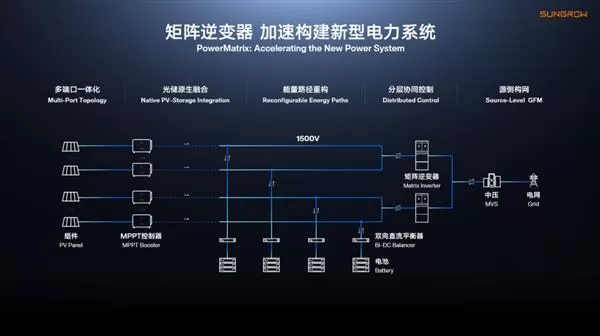
1. What is a PowerMatrix™ Matrix Inverter?
On June 3, 2026, Sungrow Power officially launched the PowerMatrix™ Matrix Inverter, along with a matrix inverter system centered around it, hailed by the industry as a game-changer. This is a completely new product category integrating photovoltaic inverter, energy storage converter, energy routing, and grid control, defined as a core energy node for new power systems.
The name "matrix" is derived from its design concept, which incorporates three key capabilities: multi-element access, multi-path connection, and multi-unit collaboration. It aims to achieve orderly collaboration and flexible scheduling among the four key components: power source, grid, load, and storage.
2. How is a Matrix Inverter System Reconfigured?
The matrix inverter system, centered around the matrix inverter, overcomes the limitations of traditional system architectures, such as decentralized coupling, single energy flow paths, and weak collaboration capabilities. Leveraging five innovative capabilities—multi-port integration, native fusion of photovoltaic and energy storage, hierarchical collaborative control, energy path reconfiguration, and source-side network construction—a new type of energy network characterized by multi-node interconnection, multi-path flow, and global collaboration has been systematically constructed, achieving systemic reconfiguration in three key dimensions:
Cost Reconfiguration: System-level optimization significantly improves economic efficiency.
BOS Cost Reduction: Based on a unified architecture and system-level collaborative design, through comprehensive cost reduction paths such as equipment integration, engineering simplification, and flexible capacity configuration, the system's BOS cost is reduced by more than 10%.
LCOE and IRR Optimization: Combined with end-to-end efficiency optimization across the generation-storage-transmission-utilization chain, the levelized cost of electricity (LCOE) is reduced by more than 2%. Taking a typical project in Northwest China (1GW photovoltaic + 2GWh energy storage) as an example, compared to traditional AC-coupled solutions, capital expenditure (CAPEX) can be reduced by approximately RMB 326 million, and the internal rate of return (IRR) can be increased by more than 1.5%.
Efficiency Restructuring: End-to-End Efficiency Improvement, System Power Generation Increased by 5%
PV-Side Efficiency Enhancement: Supports up to 28 independent MPPT tracking controls per MW, accurately tracking the maximum power point, reducing mismatch losses, and increasing PV power generation by 0.8%.
Energy Storage-Side Efficiency Enhancement: Adopts multi-level SOC balancing technology from cells to the power station, increasing the total discharge capacity of the energy storage system by 8% over its entire lifecycle.
Conversion and Transmission Efficiency Improvement: Reduces the power conversion stage by 2 levels, improving energy conversion efficiency by 3%~5%. Combined with dynamic energy path switching, further reduces line losses and ineffective energy flow.
Enhanced Absorption Capacity: Significantly enhances the flexibility of new energy access and the system's absorption capacity, promoting high-proportion or even full absorption of green electricity, effectively reducing the curtailment rate of solar and wind power.
Stability Restructuring: From "External Compensation" to "Endogenous Stability"
High Reliability Design: The system supports multi-port integrated access, achieving native integration of photovoltaic and energy storage, ensuring 24/7 green electricity supply. Natively supports a high capacity ratio of 260%, energy storage charging power of 200%, and long-term discharge capability of over 8 hours. The system's annual average utilization hours can reach up to 3000 hours, exceeding traditional photovoltaic power plants by over 100% and approaching the operating level of conventional thermal power sources.
Uninterrupted Power Supply: Equipped with over 40 operating modes, it can dynamically switch to the optimal energy path based on operating conditions, automatically isolating power sources in case of local anomalies to ensure continuous power supply around the clock.
Grid Connection Capability: The system's power generation units also possess grid connection capability. Each subarray can independently support the grid, achieving stable voltage within 10ms, providing effective inertia response within 5ms, and completing GW-level black start within 8 minutes, leading power electronic equipment from fluctuating power sources to self-stabilizing grid-connected power sources.
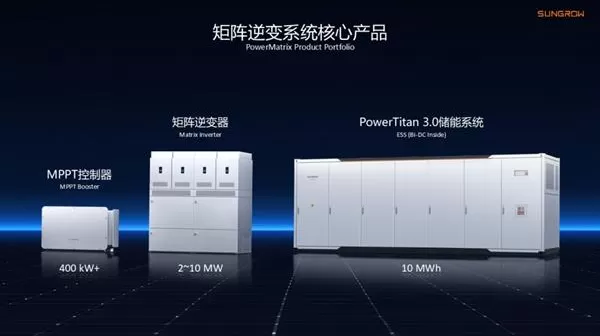
3. Significance of the PowerMatrix™ Inverter
Leveraging the aforementioned systemic advantages, the PowerMatrix™ matrix inverter system achieves superior system adaptability and operational performance in various application scenarios, including large-scale energy bases, direct green power connections, microgrids, and data centers (including AIDCs), precisely meeting the core requirements of new power systems for "multi-access, bidirectional flow, flexible dispatch, and high reliability."
The launch of the Sungrow PowerMatrix™ matrix inverter not only provides a new systemic solution to the long-standing "cost, efficiency, and stability" trilemma plaguing the photovoltaic industry, but also fundamentally breaks through the capability boundaries of new energy systems. It signifies that new energy is rapidly evolving from "intermittent power sources" reliant on subsidies and dispatch to mainstream power sources with dispatchable, supportable, and grid-connectable capabilities, contributing crucial Chinese wisdom and solutions to the global energy transition.





One step to find us,we will respond within 24 hours.
More Contact Details
008613738639386
[email protected]