
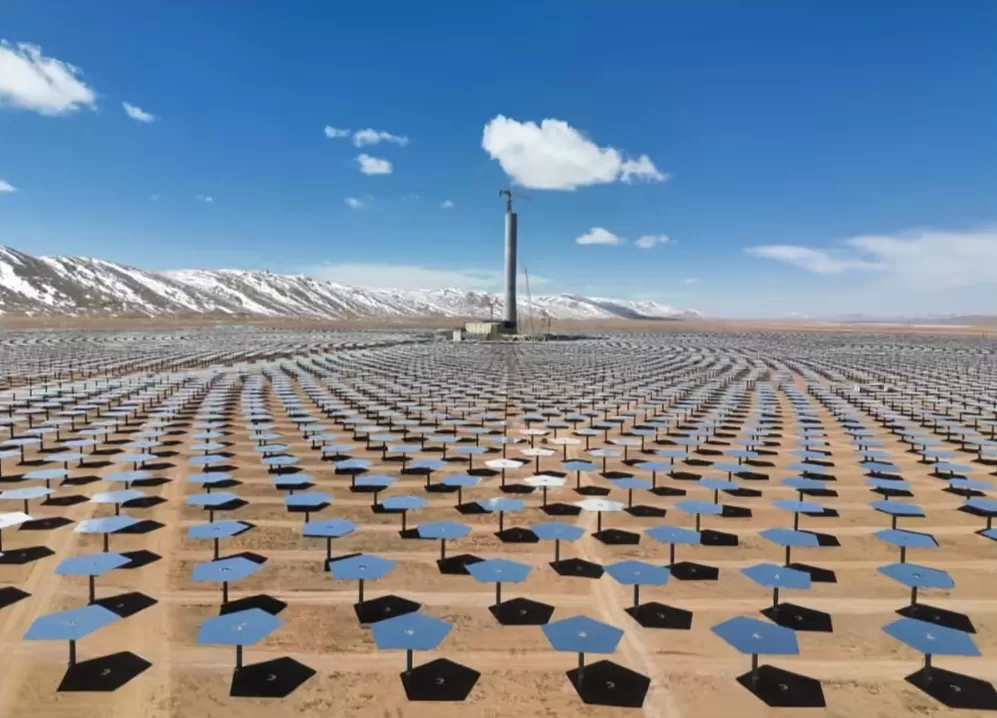
On the Tibetan Plateau of China, at an elevation of 4,650 meters, 15,927 heliostats—resembling a field of "sunflowers"—precisely track the sun, concentrating sunlight onto a 185-meter-tall central receiver tower. This facility—the Tibet Amdo Tuosuo 100 MW CSP Project—stands as the world's highest-altitude tower-type Concentrated Solar Power (CSP) plant; having fully completed the installation of its core equipment, it is now officially advancing toward the grid-connection and power generation phase. This milestone not only pushes the geographical boundaries of clean energy engineering but also offers a novel solution to the stability challenges facing global photovoltaic (PV) power plants through its inherent *dispatchable energy storage capability*.
1. CSP and PV: Not Substitutes, but Synergistic Partners
|
characteristic |
Photovoltaics (PV) |
CSP-Tower |
Synergistic Value |
|
Power generation principle |
Photovoltaic effect, direct conversion of light into electricity |
Concentrated light heating of molten salt → steam driving turbine → electricity |
Solar thermal provides a stable base load, while photovoltaics contributes peak power output. |
|
Energy storage capacity |
It has no built-in energy storage and relies on an external battery. |
Equipped with an 8-hour binary molten salt thermal storage system, it can generate electricity continuously at night. |
Solar thermal energy storage can replace some of the lithium battery demand and reduce system costs. |
|
Output characteristics |
Affected by cloud cover and diurnal fluctuations, it is highly intermittent. |
Dispatchable and predictable, with stable output similar to thermal power. |
Enhance grid resilience and reduce curtailment rate of solar power. |
|
High altitude adaptability |
Efficiency is only slightly affected by low temperatures, and installation is flexible. |
Achieving engineering breakthroughs in an environment of extreme cold, low oxygen, and strong winds at an altitude of 4650 meters. |
Proving that clean energy can operate stably in "no man's land" |
|
Unit cost |
Approximately 800–1,200/kW |
Approximately 2,200–3,000kW |
Solar thermal energy can act as a "stabilizer" to reduce overall system energy storage investment. |
Key Insight: If PV is the "lightning," then CSP is the "heart." In regions characterized by high solar irradiance and weak grid infrastructure—such as Tibet, Qinghai, and Chile's Atacama Desert—*hybrid "CSP + PV" power plants* are emerging as the "golden combination" for the next generation of clean energy architecture.
2. The Amdo Project: A Technical Blueprint for "Bridging the Gaps" in PV Systems
Thermal Storage Equals Stability: The 100 MW CSP project is equipped with an 8-hour molten salt thermal storage system, enabling it to achieve an *average of 16 hours of continuous power generation per day*. By continuing to provide base-load power to the grid after sunset, it effectively mitigates the inherent limitation of PV systems—namely, that they "stop generating power the moment the sun goes down."
Zero-Carbon Base Load: Generating 255 million kilowatt-hours of electricity annually, the project is equivalent to reducing CO₂ emissions by 165,000 tons per year. Furthermore, its full life-cycle carbon footprint stands at a mere 13–19 g/kWh—significantly lower than that of fossil fuels.
A High-Altitude Engineering Marvel: Operating in a "storehouse of wind and snow"—where oxygen levels are less than 60% of those at sea level and wind speeds frequently exceed 30 m/s—the project team pioneered the use of *modular heliostat assembly (conducted on-site)* and *adaptive solar-tracking algorithms*. This innovation has achieved a heliostat tracking precision of *0.061 degrees*—an accuracy equivalent to each mirror precisely "hitting" a coin-sized target located 1.5 kilometers away. Grid-Friendly Design: Located in a region of Tibet characterized by a weak power grid, this project leverages the inherent thermal inertia of CSP (Concentrated Solar Power) to effectively mitigate voltage fluctuations, thereby serving as a crucial "buffer" for the future large-scale integration of PV (photovoltaic) power into the grid.
3. Global Trends: CSP Is No Longer a "Niche Technology," but a System-Level Solution
An IEA report highlights that by 2025, global annual additions to PV installed capacity are projected to exceed 400 GW; however, the pressure on power grids to absorb this capacity is rising in tandem. CSP systems equipped with thermal energy storage have emerged as one of the few technological pathways capable of delivering "dispatchable renewable energy."
Research by SolarPACES indicates that in copper mining projects in Chile, hybrid CSP+PV systems have reduced the Levelized Cost of Electricity (LCOE) by 18%, while simultaneously boosting power supply reliability to 99.2%.
Chinese Practice: Integrated "CSP+PV" projects have already been successfully commissioned in locations such as Gonghe (Qinghai) and Guazhou (Gansu). Notably, the Phase II project of the National Energy Group’s Qinghai-Henan UHV DC transmission line—utilizing a combination of 23,000 heliostats and PV arrays—achieved a thermal storage capacity of 12 hours. This facility stands as the world's first megawatt-scale hybrid power station characterized by a "CSP-dominant, PV-supplementary" operational model.
4. Future Outlook: An Evolving Narrative for PV Projects
Moving "from selling components alone" to "selling system stability," PV enterprises should no longer limit their messaging to metrics such as "cost per watt" or "conversion efficiency." Instead, they should articulate a more compelling narrative: "How do we make sunlight available 24 hours a day?"
The Ando project serves as compelling proof that within the broader landscape of solar energy, CSP is not a rival to PV; rather, it represents the critical missing piece of the puzzle—the element that enables PV to truly assume the role of a "primary power source."
Over the coming decade, global solar projects will increasingly adopt a hybrid architecture—one that is "PV-centric with CSP as a complement." The objective is not to displace existing technologies, but to ensure that clean energy becomes, in every sense, truly reliable.



One step to find us,we will respond within 24 hours.
More Contact Details
008613738639386
[email protected]