
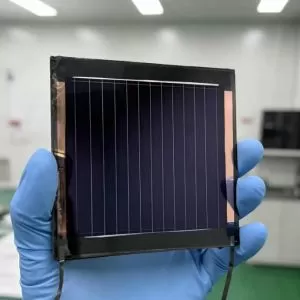
A team led by Professor Wang Zhiping from the School of Physics Science and Technology at Wuhan University published groundbreaking results in the journal *Science*, pioneering an "atomic-scale interface bonding" technology. This successfully solves the long-standing global challenge of simultaneously improving the efficiency and stability of perovskite solar cells. This technology enables p-i-n type perovskite cells to achieve:
Power conversion efficiency: 27.1% (third-party certified efficiency 26.6%)
High-temperature stability: Maintaining over 90% of initial efficiency after more than 5000 hours of operation at 85°C under continuous standard sunlight exposure
Lifespan improvement: High-temperature operating lifespan (T90) is 25 times that of conventional control devices.
This achievement marks a crucial step in the transition of perovskite photovoltaic technology from the laboratory to large-scale application.

1. Detailed Explanation of Technical Principles: Atomic-Level Precise Interface Control
Traditional perovskite solar cells rely on organic molecular layers to modify the interface, but these layers are prone to decomposition under continuous light and high temperatures, leading to charge transport failure, accelerated ion migration, and ultimately performance degradation. Wang Zhiping's team took a different approach, employing atomic layer deposition (ALD) technology to precisely introduce a hafnium oxide (HfOx) inorganic intermediate layer at the core interface of the cell, achieving simultaneous stabilization of the hole transport layer (HTL) and electron transport layer (ETL):
|
Interface location |
HfOx Mechanism of Action |
Functional effects |
|
Hole Transport Layer (HTL) Interface |
After annealing, a hydroxyl-rich n-type HfOx layer is formed, which formsa high-strength tripentate coordination structure with the self-assembled molecules. |
Significantly improves interfacial thermal stability and mechanical adhesion, and inhibits molecular desorption. |
|
Electron Transport Layer (ETL) Interface |
Constructing a p-type HfOx layer and anchoring passivated molecules throughstrong Hf···F bonding . |
Effectively blocks the migration of iodide ions to the metal electrode, thus delaying degradation at the source. |
This mechanism achieves, for the first time, the synergistic passivation and structural strengthening of the two interfaces by inorganic oxides at the atomic scale, breaking through the "efficiency-stability trade-off" dilemma.
2. Experimental Data and Validation Standards
|
index |
numerical values |
Test conditions |
|
Power conversion efficiency (PCE) |
27.1% (Laboratory) |
AM 1.5G, 100 mW/cm² |
|
T90 lifespan |
>5000 hours |
85°C, continuous 1 day of sunlight |
|
Efficiency retention rate |
≥90% |
5000 hours later |
|
Process compatibility |
Compatible with roll-to-roll (R2R) and coating processes |
No device reconfiguration required |
Note: T90 refers to the time required for the device efficiency to decay to 90% of its initial value, a core indicator for measuring long-term stability in the photovoltaic industry.
3. Industrialization Prospects and Technological Advantages
Process Compatibility: Atomic layer deposition technology can be seamlessly integrated into existing photovoltaic production lines without disruptive equipment modifications, ensuring controllable mass production costs.
Patent Layout: A complete intellectual property system has been established for related technologies, providing legal protection for subsequent commercialization.
Application Potential: Applicable to emerging scenarios such as building-integrated photovoltaics (BIPV), flexible wearable devices, and lightweight drone power supplies.
Cost Advantage: The cost of perovskite materials is only about one-third that of crystalline silicon cells. Combined with the breakthrough in stability achieved in this project, the cost per kilowatt-hour is expected to rapidly approach and even fall below that of crystalline silicon.
4. Research Team and Support System
Corresponding Author: Professor Zhiping Wang (School of Physics Science and Technology, Wuhan University)
First Author: Yuanhang Yang (Postdoctoral Fellow), Siyang Cheng (PhD Candidate)
Supporting Institutions: National Natural Science Foundation of China, National Key R&D Program of China, Wuhan University Scientific Research Public Service Platform
This achievement is a model of basic research driving industrial transformation, reflecting China's leading position in the next generation of photovoltaic technology.
5. Industry Impact and Technological Paradigm Shift
Previously, global research largely focused on material composition optimization (such as A-site cation engineering and halogen doping) or encapsulation technologies (such as glass-polymer composite encapsulation). The Wuhan University team has pioneered the concept of interface structure engineering as the primary pathway for stability control, creating a new paradigm of "synergistic stabilization mechanism of inorganic oxide interlayers," considered a landmark breakthrough in perovskite stability research.
"This work is not an incremental improvement, but rather a redefinition of the design logic for stability." — An anonymous comment from an international photovoltaic materials expert.




One step to find us,we will respond within 24 hours.
More Contact Details
008613738639386
[email protected]