
A joint team from the Institute of Process Engineering (Chinese Academy of Sciences) and Shenzhen University has recently achieved a major technological breakthrough in the field of solar photothermal desalination. The team proposed a novel material fabrication strategy based on a polymer "locking" mechanism, successfully weaving photothermal nanoparticles into a 3D structured evaporation material. This innovation significantly boosts solar energy utilization efficiency while resolving critical industry issues—specifically, the detachment of photothermal particles and the degradation of organic substrates—that have long plagued traditional materials. The technology has already undergone outdoor field testing and achieved 100-gram-scale production, laying a foundational material basis for the large-scale implementation of solar desalination.
Two Core Bottlenecks in Photothermal Desalination Technology
Solar interfacial evaporation technology is regarded as a vital solution to global freshwater scarcity due to its zero-energy consumption and eco-friendly nature; it is particularly well-suited for meeting water supply needs in coastal areas facing water shortages, islands, and remote off-grid regions. However, the industrialization of this technology has consistently faced two major, stubborn bottlenecks:
First is the challenge of assembling nanoparticles into 3D structures. While high-performance photothermal nanoparticles offer excellent photothermal conversion capabilities, they tend to aggregate easily when assembled into macroscopic devices. This aggregation reduces light-trapping efficiency and clogs water transport channels, leading to a sharp decline in performance. Furthermore, traditional 3D structures often suffer from low mechanical strength and high manufacturing costs, making large-scale replication difficult.
Second is the challenge of long-term operational stability. Most organic substrate materials degrade under prolonged exposure to light due to reactive radicals generated via photocatalysis. Additionally, the washing action of seawater and the crystallization of salts can cause photothermal particles to detach, resulting in a short material lifespan that fails to meet the requirements for long-term outdoor operation.
The joint team's research has achieved targeted breakthroughs addressing these two critical industry pain points; the findings have been published in the top-tier materials science journal *Advanced Materials*.
Constructing a 3D "Nano-Forest" via a Polymer "Locking" Mechanism
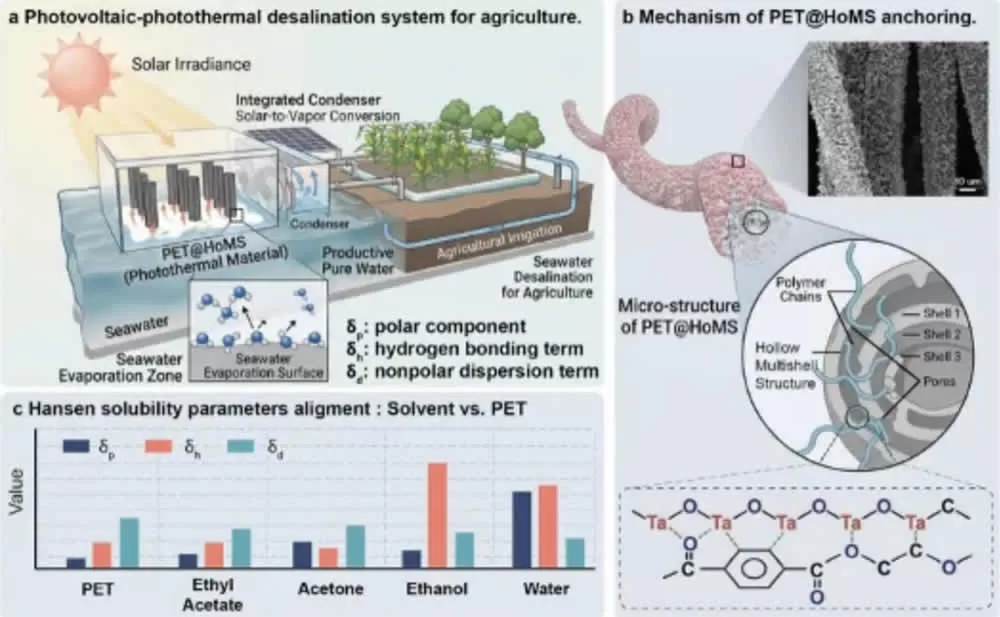
To overcome the dual challenges of material assembly and stability, the research team innovatively proposed a polymer "locking" mechanism, restructuring the fabrication logic of photothermal evaporation materials at the microstructural level. The team first synthesized amorphous tantalum pentoxide/carbon composite hollow multi-shell (HoMS) nanospheres to serve as structural "buttons." Subsequently, applying Hansen solubility parameter theory, they enabled polyester (PET) polymer chains—acting like "sewing thread"—to precisely penetrate the porous structure of the nanospheres. These chains firmly anchored the particles via molecular-level binding sites, ultimately weaving them into a stable, three-dimensional network that forms a porous framework resembling a "nano-forest."
This structural design yields dual performance benefits:
Structural level: It prevents nanoparticle agglomeration and clogging while creating continuous, efficient channels for water transport and vapor escape through the 3D pore network, thereby significantly increasing the effective evaporation surface area. Simultaneously, the material's mechanical strength is markedly enhanced, enabling it to withstand seawater erosion and salt crystal accumulation.
Stability level: The tantalum pentoxide-based photothermal material does not generate reactive free radicals under illumination, fundamentally eliminating the root cause of organic substrate degradation. The polymer "locking" structure firmly secures the nanoparticles, completely resolving the issue of particle detachment.
Core metrics set new industry benchmarks
Driven by this innovative structural design, the 3D photothermal evaporation material has achieved a qualitative leap in performance, comprehensively surpassing traditional 2D thin-film materials.
Regarding light absorption and energy consumption, the 3D structure utilizes internal multiple light scattering and absorption effects to achieve a 90.2% absorption rate across the full solar spectrum, enabling highly efficient solar energy capture and conversion. Furthermore, the nanoconfined space restructures the hydrogen-bonding network between water molecules, reducing the energy required to evaporate a given amount of water by 45.7% and significantly boosting energy utilization efficiency.
In terms of evaporation rate, under standard "1-sun" irradiation testing, a single evaporation unit achieved a rate of 38.14 kg·m⁻²·h⁻¹. This is 8.5 times the rate of the 2D thin-film material previously developed by the team (4.02 kg·m⁻²·h⁻¹), setting a new performance record for this class of technology. Regarding long-term stability, the material showed no nanoparticle loss and negligible degradation in photothermal conversion performance after undergoing a continuous 30-day accelerated seawater aging test. In contrast, a conventional material lacking the interlocking structure exhibited massive particle loss after just 12 days of operation, with evaporation efficiency dropping by 42%; the new technology thus achieved a multi-fold increase in service life.
Validation Across Scenarios: From Drinking Water to Agricultural Irrigation
The research team did not stop at laboratory performance metrics; instead, they simultaneously advanced the material's mass production and outdoor system validation, successfully bridging the gap between laboratory results and practical application.
In terms of production capabilities, the team employed a sequential templating method. By precisely controlling processes using a 20-liter hydrothermal reactor and a multi-zone tunnel furnace, they achieved stable, quantitative production at the 100-gram scale at the Chinese Academy of Sciences' Langfang Engineering Pilot Base, establishing the process foundation for further scaling up.
Regarding outdoor field testing, the team constructed a complete outdoor test setup with an area of 0.75 square meters. Under natural sunlight, the device produced 20.16 liters of fresh water daily—sufficient to meet the basic drinking water needs of approximately 10 people. Testing confirmed that the produced fresh water fully met World Health Organization (WHO) standards for drinking water.
Of even greater industrial value is the technology's successful validation across the full cycle of agricultural irrigation. The desalinated seawater was used to continuously irrigate a 5-square-meter plot of farmland for a full year; crops such as spinach, corn, and bok choy successfully completed their entire growth cycles. This demonstrated the feasibility of using desalinated water for agricultural production and expanded the technology's scope of application.
A full life-cycle cost analysis indicates that after two years of operation, the cost of water production will fall below that of commercially available bottled water, demonstrating significant economic competitiveness.
Expanding Application Scenarios for Solar Photothermal Technology
As a key branch of solar energy utilization, photothermal seawater desalination complements photovoltaic power generation, together forming an industrial landscape of diversified solar energy use. This breakthrough in 3D photothermal materials not only drives the upgrading of seawater desalination technology but also opens up possibilities for applying solar photothermal technology in a wider range of scenarios.
Currently, the research team is further optimizing the system's condensation efficiency and overall cost to facilitate the large-scale deployment of this technology in coastal water-scarce villages, island garrisons, oceangoing vessels, and remote off-grid areas. Looking ahead, as material fabrication processes are scaled up and system integration designs are refined, solar-thermal seawater desalination is poised to become a major avenue for solar energy utilization—alongside photovoltaics—offering a green, sustainable Chinese solution to the global water scarcity crisis.






One step to find us,we will respond within 24 hours.
More Contact Details
008613738639386
[email protected]