
Perovskite solar cells, as a highly promising next-generation photovoltaic technology, have continuously broken efficiency records in laboratories due to their advantages of high efficiency, low cost, and flexible fabrication. However, their commercialization process has long been hampered by the core bottleneck of insufficient stability, especially in terms of long-term reliable operation under actual working conditions. Recently, several groundbreaking research results have been announced internationally, addressing the problem from the fundamental levels of materials and processes, injecting strong confidence into the large-scale and industrial application of perovskite cells, and demonstrating the great potential of diverse technological pathways to solve the stability problem. This article will integrate the latest scientific research progress to summarize the key technological breakthroughs in achieving stable perovskite cells.

1. "Molecular Glue" Technology Provides a Boost for Flexible Perovskites
Traditional perovskite cells suffer from rapid performance degradation in humid or high-temperature environments, becoming a key obstacle to their commercialization. In response, an innovative surface engineering strategy has achieved significant results.
According to recent reports, Professor Thomas Anthopoulos's team at the University of Manchester in the UK has achieved a key breakthrough. They introduced a small molecule amidine ligand, known as "molecular glue," to effectively optimize the perovskite structure. The core of this technology is that this "molecular glue" forms a dense protective layer on the surface of the perovskite material. This protective layer precisely guides the perovskite to form a stable low-dimensional structure through chemical bonds, perfectly covering the surface of the traditional three-dimensional perovskite.
The beauty of this coating lies in its dual function: first, it effectively repairs microscopic defects on the crystal surface, making the film layer smoother and thus reducing non-radiative recombination energy losses caused by defects; second, it creates a robust barrier that effectively inhibits material decomposition under high-temperature operating conditions. The experimental test results are exciting: the perovskite solar cells treated with this technology not only achieved a photoelectric conversion efficiency of up to 25.4%, but also maintained more than 95% of their initial performance after 1100 hours of continuous operation. Particularly noteworthy is that the battery can operate stably in a high-temperature environment of 85°C, breaking through the temperature tolerance limit of traditional perovskite batteries. This technology significantly expands the application boundaries of perovskite solar cells, enabling them to be printed on flexible substrates such as curved glass, lightweight camping equipment, and even textiles, opening up new avenues for the deep integration of photovoltaic technology with wearable and mobile energy.
2. A New Approach to Crystallization Process
The thermal annealing step in device fabrication is a major "trigger" that induces defects in perovskite thin films and accelerates their structural degradation. Achieving both high-quality crystallization and low defect density simultaneously during this essential process is a key focus for research teams worldwide.
In response, a Chinese research team has proposed an innovative solution. Professor Liang Chao's team at Xi'an Jiaotong University, in collaboration with Professor Zhang Jinbao's team at Xiamen University, developed a "solid-state molecular imprinting annealing" strategy. This method cleverly imprints a dense layer of pyridine-based molecular templates (specifically 2-pyridineethylamine) onto the perovskite surface in situ during the thermal annealing process. The core mechanism is to achieve molecular-scale "in-situ constraint" of the perovskite lattice structure under "solid-state" conditions without introducing any solvents.
The designed ligand molecules form stable bidentate coordination structures with the undercoordinated lead ions on the surface, "locking" and stabilizing the perovskite's lead-iodine framework throughout the annealing process. This effectively suppresses the generation and diffusion of iodine vacancies at the source, blocking the chain reaction of structural degradation caused by thermal stress. As a result, the perovskite thin film achieves synergistic optimization of high crystallization quality and extremely low defect density, significantly improving charge transport and collection efficiency.
Batteries fabricated using this technology have achieved outstanding performance: small-area device efficiency reached 26.6%, and 1 cm² device efficiency reached 24.9%. Even more remarkable is their exceptional stability. Under harsh conditions of 85°C and 60% relative humidity (ISOS-L-3 standard), the battery efficiency remained above 98% after 1600 hours of continuous operation; under normal environmental storage conditions, there was no significant performance degradation after more than 5000 hours.
3. Exploring Scalable and Stable Technologies for Industrialization
The key to industrialization lies in solving the stability problem of large-area modules. Previously, vapor-phase fluorination technology had been proven to significantly improve the long-term stability of large-area modules indoors, but its production requires specialized equipment, increasing cost and complexity.
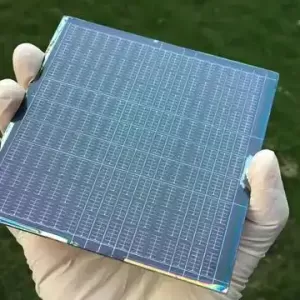
To address this, the team led by Academician Guo Wanlin of the Chinese Academy of Sciences has continuously innovated, developing "vapor-assisted surface reconstruction technology." This technology aims to suppress the irreversible degradation of industrial-grade perovskite modules in real outdoor environments. The research successfully achieved outdoor operating stability comparable to commercial crystalline silicon solar cells on a large-area 30 cm × 30 cm perovskite module for the first time, providing a systematic technological closed loop for the stability of the entire "laboratory-production line-outdoor" chain of perovskite photovoltaics.
Meanwhile, research from Kunming University of Science and Technology provides a "universal strategy" starting from inhibiting ion migration. The team of Professors Chen Jiangzhao and He Dongmei utilized the host-guest interaction of calixarene supramolecules to simultaneously inhibit the migration of various chemical species (ions) in perovskite devices—another core mechanism leading to device performance degradation. The inverted cells prepared using this strategy achieved an efficiency of 27.18% and demonstrated excellent stability under unencapsulated conditions: maintaining over 90% efficiency after 1200 hours of continuous operation at the maximum power point; and maintaining over 90% of the initial efficiency after 1500 hours of thermal aging at 65°C.
Conclusion and Outlook
Recent research progress clearly shows that through innovative material design, interface engineering, and process optimization, the stability of perovskite solar cells is undergoing a qualitative leap. Whether it's the "molecular glue" technology from the UK or China's "molecular imprinting annealing" and "vapor-assisted reconstruction," they all provide solid and feasible technical solutions from different dimensions to overcome the stability challenge. These breakthroughs are not only reflected in small-area devices in the laboratory but have also been verified in applications scaled up to the module level. As these technologies mature and integrate, the future of perovskite photovoltaic technology breaking through commercialization bottlenecks and moving towards widespread application is clearly visible, and it is expected to contribute disruptive power to the global renewable energy transition.




One step to find us,we will respond within 24 hours.
More Contact Details
008613738639386
[email protected]